Wonderlandscape
One of us has been re-reading Alice in Wonderland by Lewis Carroll (aka Charles Dodgson) and we have discovered how relevant this 19th century children’s book is to anyone interested in 21st century landscapes.
We’ll tell you why we’ve been rediscovering Alice and the White Rabbit in a minute, but re-reading as an adult revealed many caricatures of modern situations. Take the Caucus-race: the Dodo (thought to be based on Charles Dodgson himself) marks out a race course, and places the participants here and there along it. Chaos ensues when runners set off or stop whenever they feel like it. How many business meetings or family discussions have you encountered, which feel just like that? The Dodo declares all to be winners and insists that Alice supply the prizes. She complies and finally presents herself with her own thimble. A classic representation of having a brilliant idea, only to have it adopted by someone else and presented back to you as their own wonderful work.
The trial of the Knave of Hearts reminds us of the Planning Inquiry which we recently endured (regular readers will be aware of this, see Qimby - Blog 167, and ‘How do I love thee’ - Blog 173). We have just had great news: the Queen of Hearts – no, no, the planning Inspector - has dismissed the developer’s appeal, to the delight of the local community group and, we hope, the local planning authority.
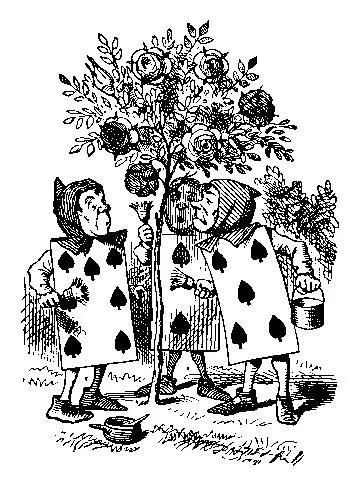
And of course we’ve all been caught ‘painting the roses’. Poor gardeners: ‘Two’ (of Clubs) explains that they have planted a white rose tree instead of a red one. Rather than be beheaded by the Queen of Hearts (no, definitely not the planning inspector) the gardeners are busily applying red paint to the offending flowers. It’s also very reminiscent of The Traitors. In this case, banishment plays out in Ardross Castle, located in a glorious Scottish highland valley, north west of Invergordon (below right).
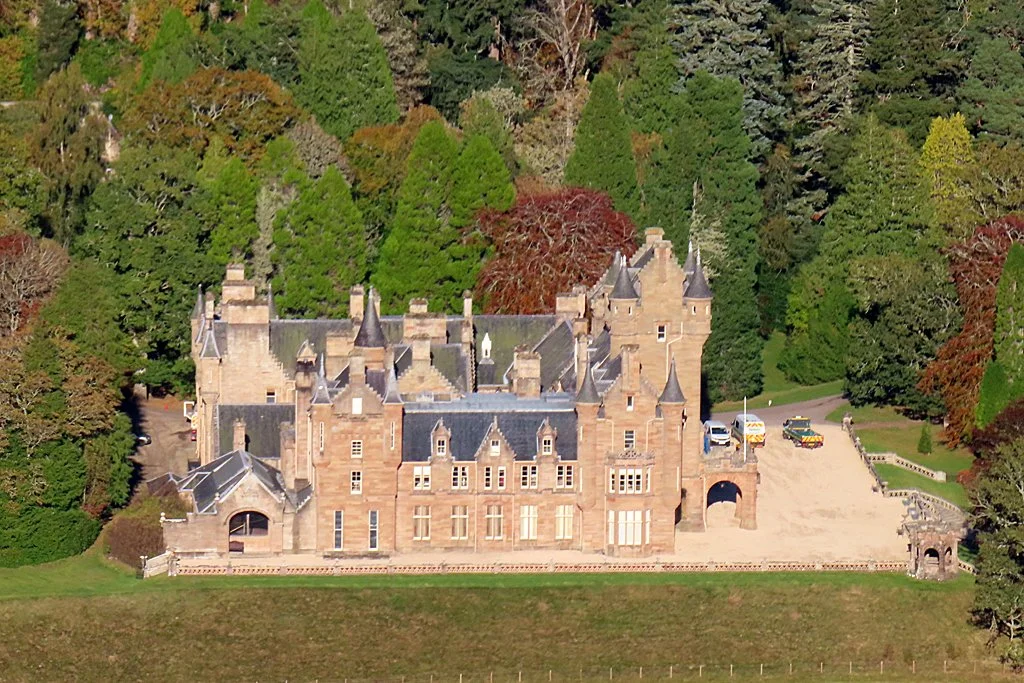
By Anne Burgess, CC BY-SA 2.0, https://commons.wikimedia.org/w/index.php?curid=177648807
Our obsession with Alice’s visit to Wonderland-scape was actually sparked off by the National Trust. Our first introduction to visiting Trust properties at Christmas was PC (Pre Covid), when we enlivened a long drive with coffee, cake and Christmas at Greys Court (below) and, on the way back, at Prime Minister Disraeli’s home at Hughenden Manor. Both houses were pretty much decorated for a Christmas season appropriate to their history and inhabitants, and Hughenden had an excellent display of good old fashioned paper chains.
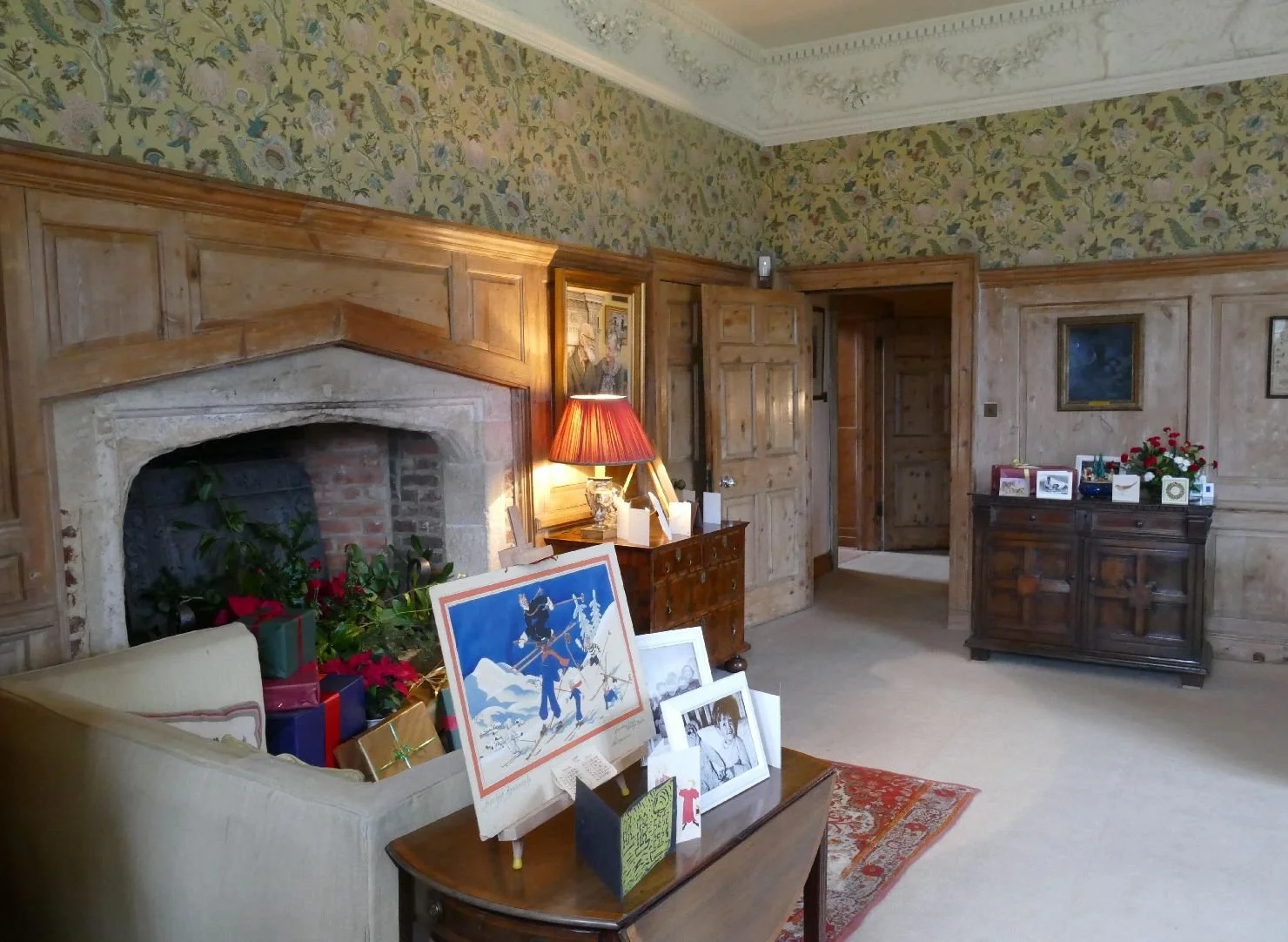
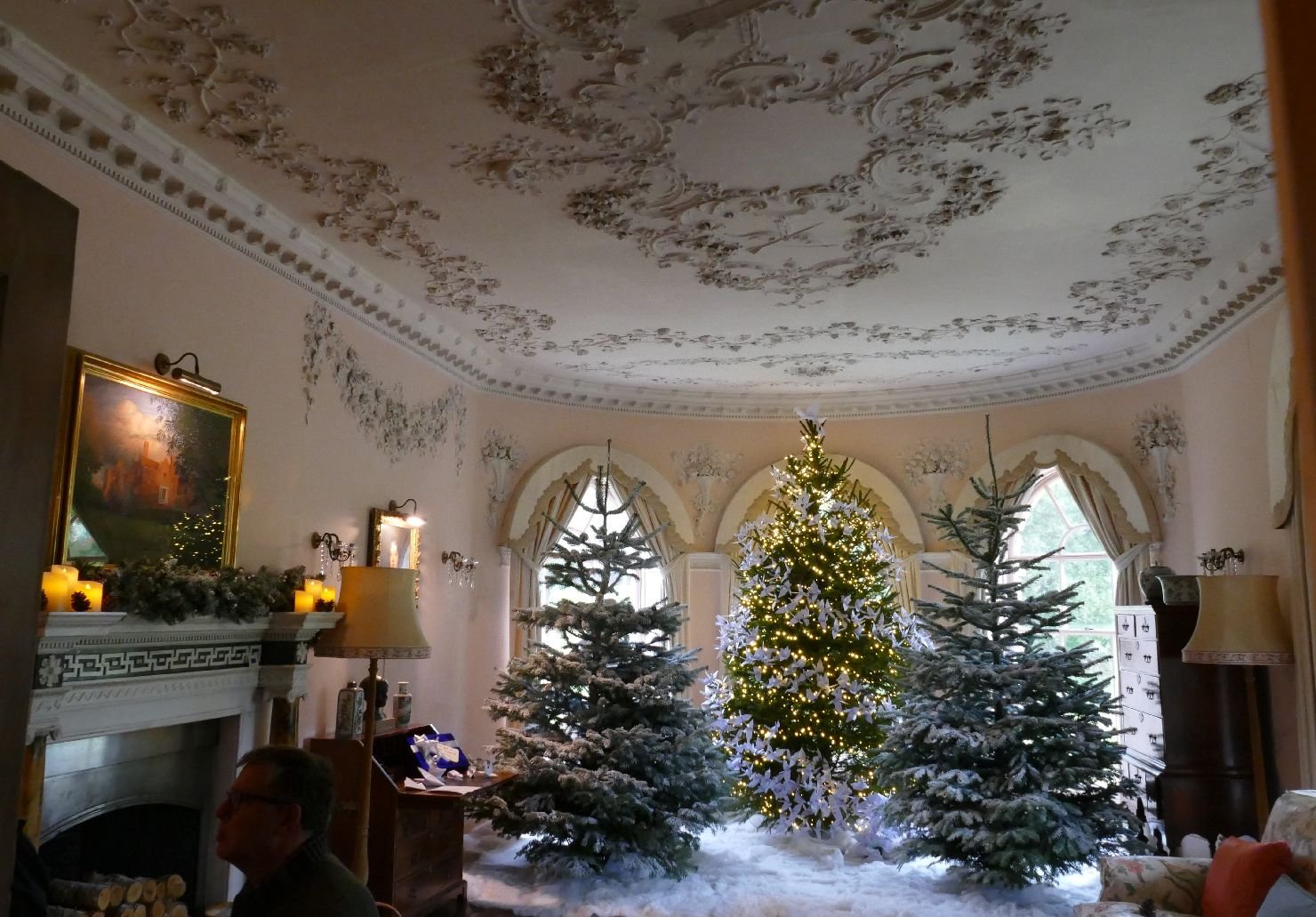
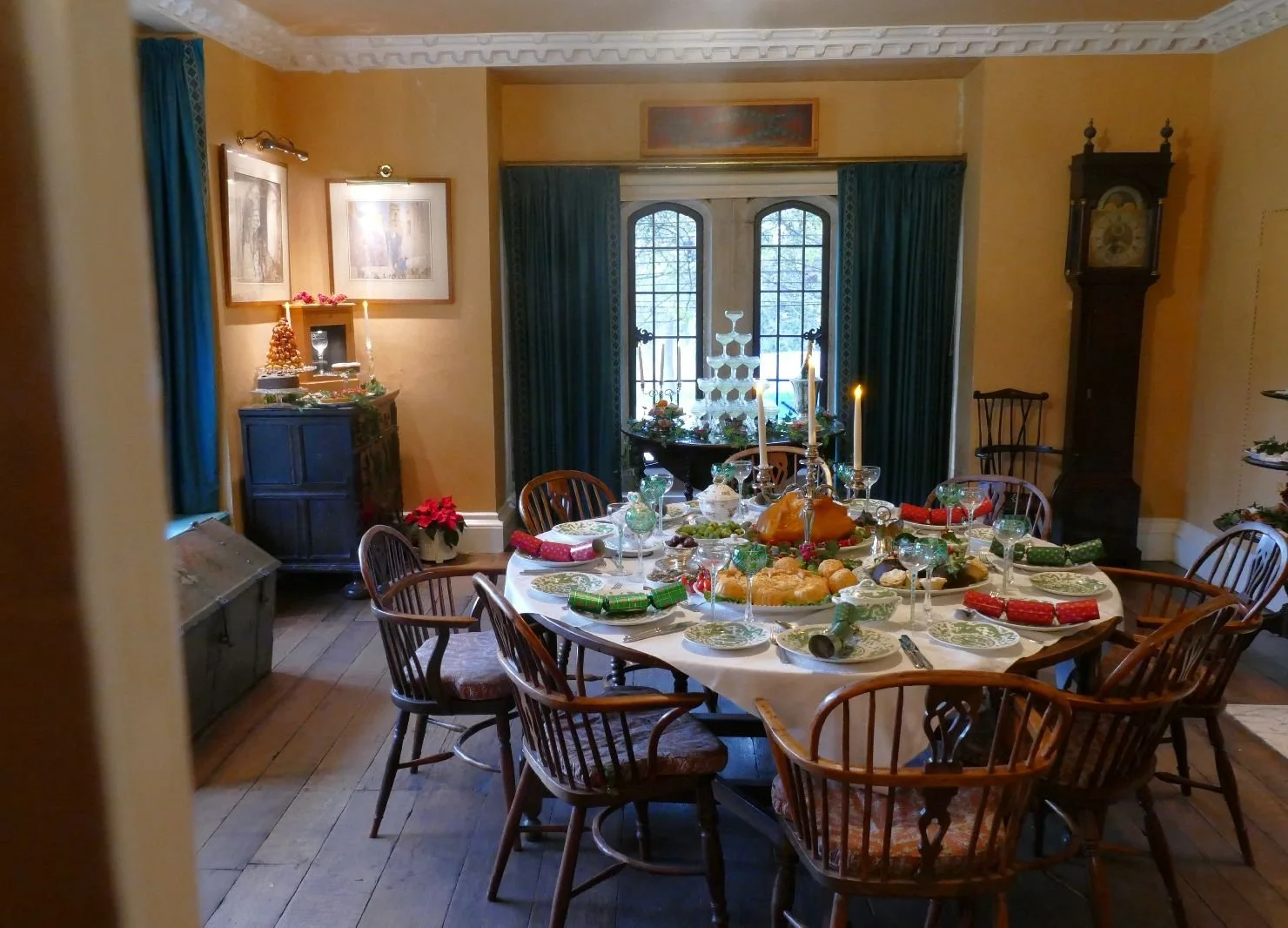
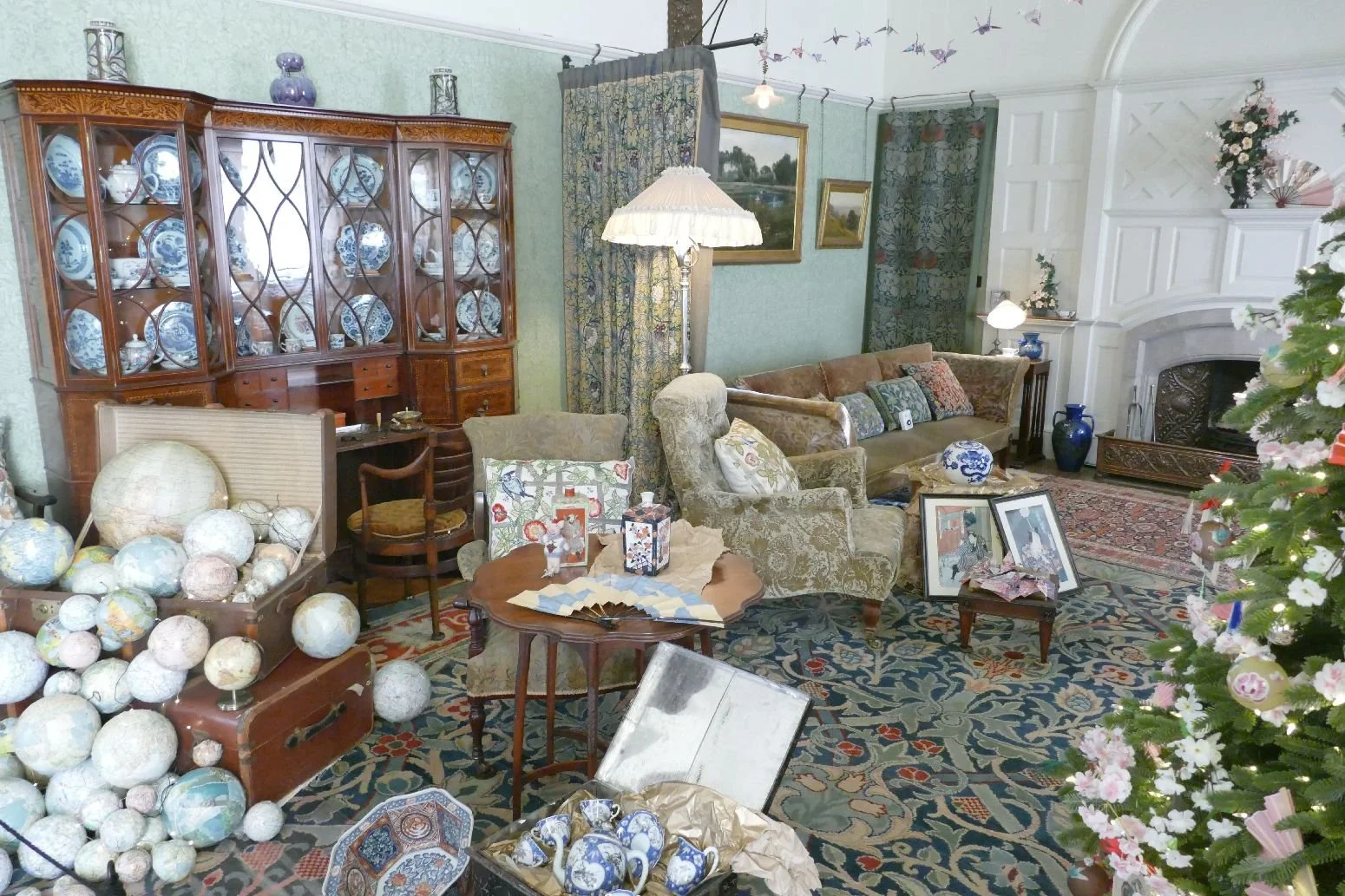
Things have moved on considerably since then. It’s Christmas 2025, and Standen – an Arts and Crafts property in West Sussex - was bristling with Christmas trees and messages to Father Christmas representing the family and staff who might have been in residence over the festive season. The decorations took their theme from the wish lists and expanded on them significantly!
Above: a map lover’s Christmas
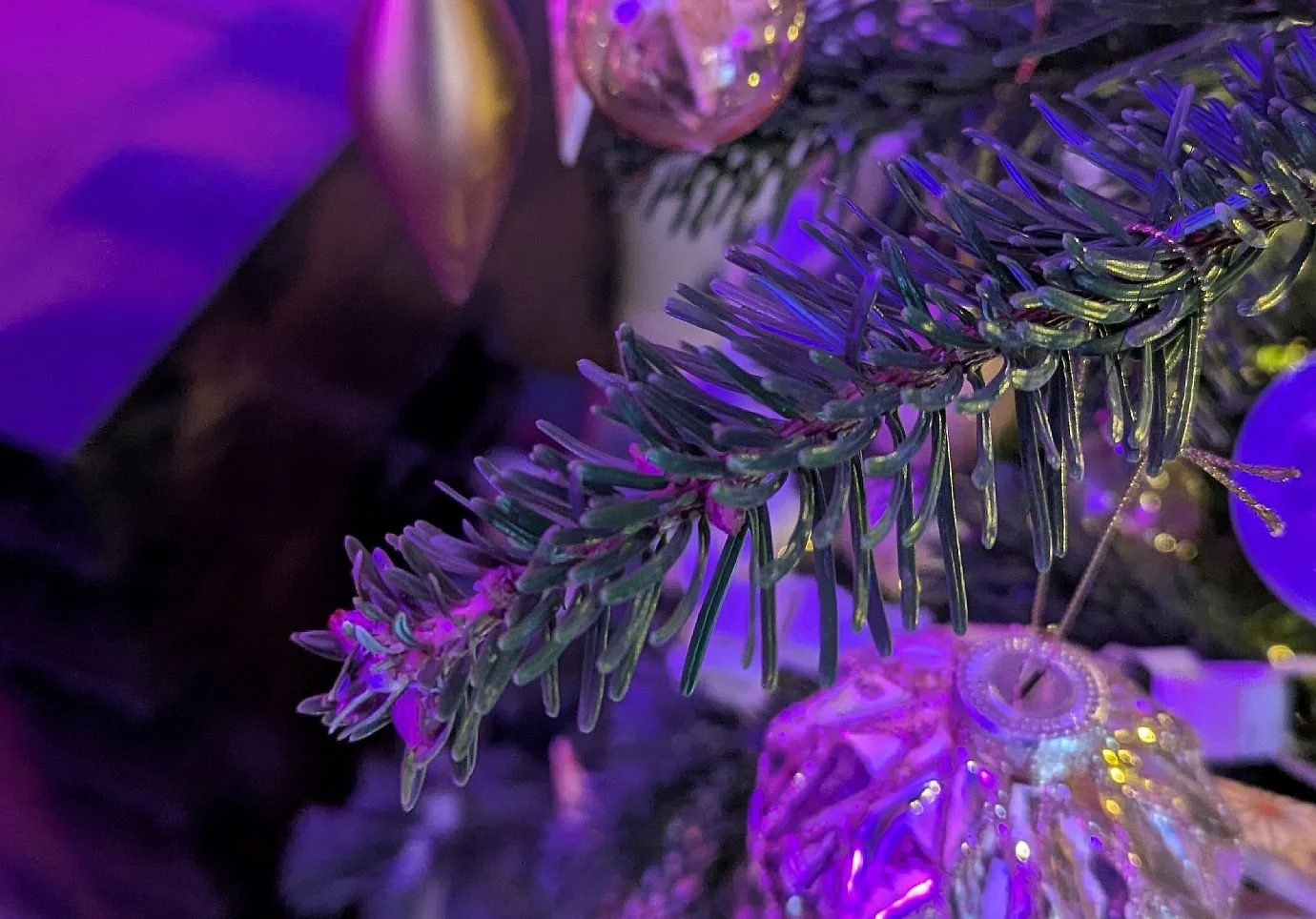
Our only problem with Standen was those Christmas trees. Not because they are plastic (unfortunate of course but we can understand the convenience and re-use factors) but because they are obviously Nordmann firs (see image right, and our Christmas Day blog entitled ‘ Christmas Trees’). Even our plant identification app thought they were Abies Nordmanniana!
Surely the historically appropriate Christmas tree for a house of Standen’s vintage would have been a Norway Spruce? But I suspect we should blame the artificial tree manufacturers rather than the National Trust.
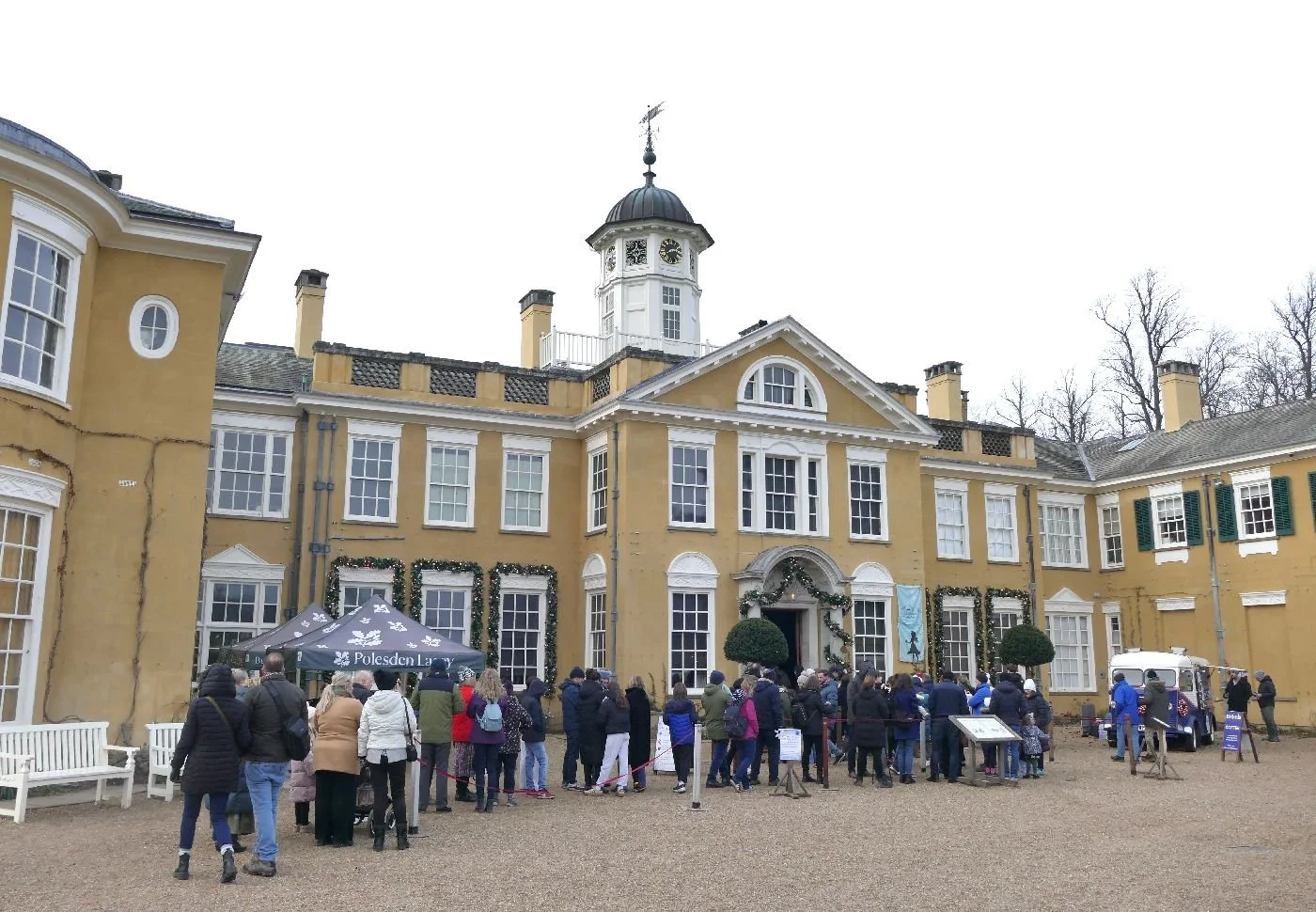
Going back to adventurous Alice in Wonderland, however, we discovered she had taken up residence in Polesden Lacey (right), the Edwardian makeover of a much older building, which became the Surrey home of society hostess Dame Margaret Greville.
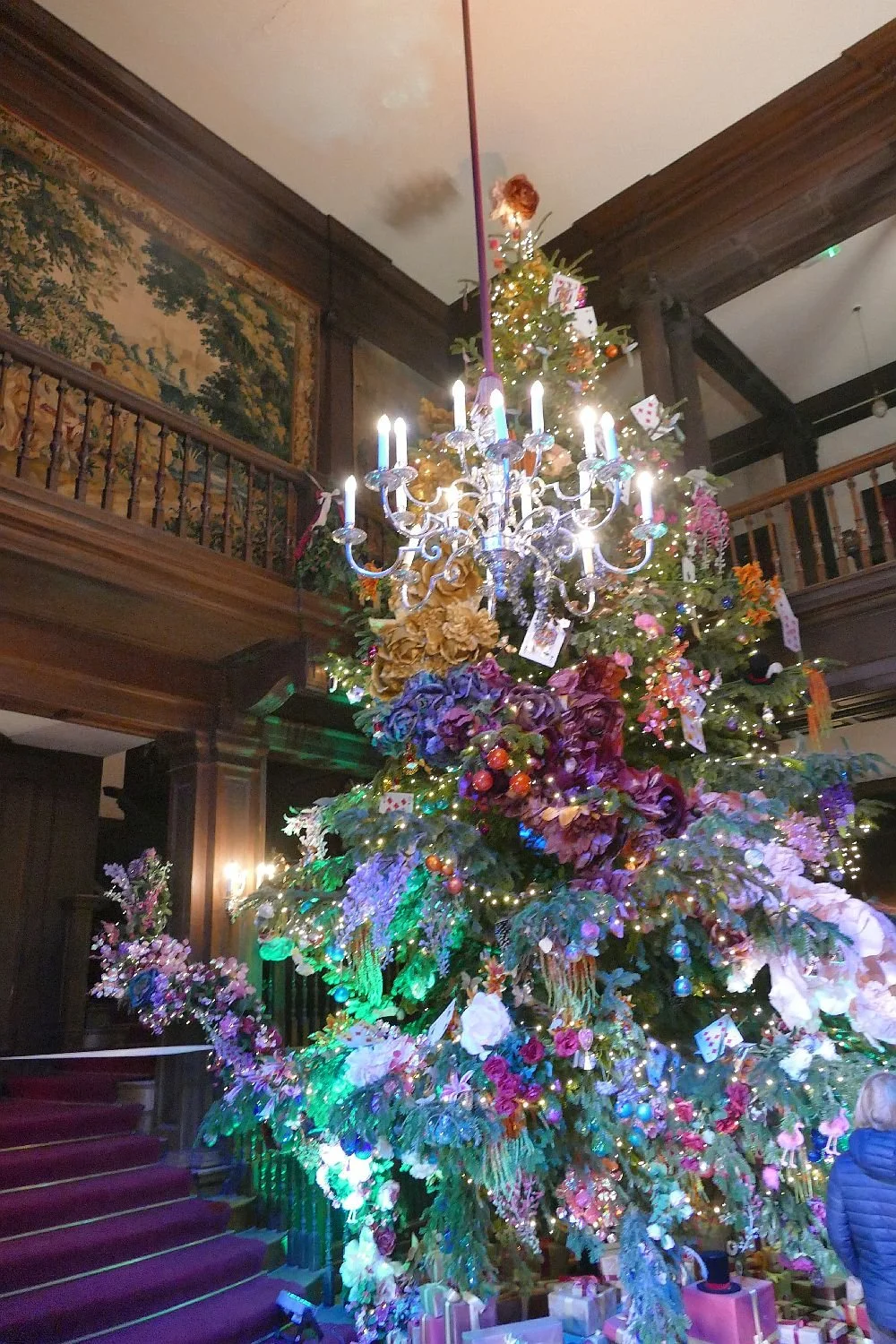
We have visited Polesden Lacey many times so it was something of a shock to walk into an entrance hall stuffed, festooned and swagged (is that a word?) with a riot of artificial flowers which smacked of the tropics rather than the Home Counties. The Christmas tree (left) was a actually a pale example of the oversized and over colourful blooms which filled the space.
Of course we hadn’t done our homework but it didn’t take long to realise that Polesden Lacey’s interior had gone down a rabbit hole and had emerged in the garden of Lewis Carroll’s imagination. In our ‘eNotated’ version of ‘Alice in Wonderland’ the introduction reads: “Perhaps without truly intending to, Lewis Carroll peppered this children’s classic with death, mutilation, racism, politics and savagery while also dealing with anger, confusion, memory, logic, reason, women’s role, and insanity.” (eNotated by PamSowers – 2012). To be honest, I didn’t quite get all that when I read it as a child, but I did register fear, confusion, and a smattering of incredulity!
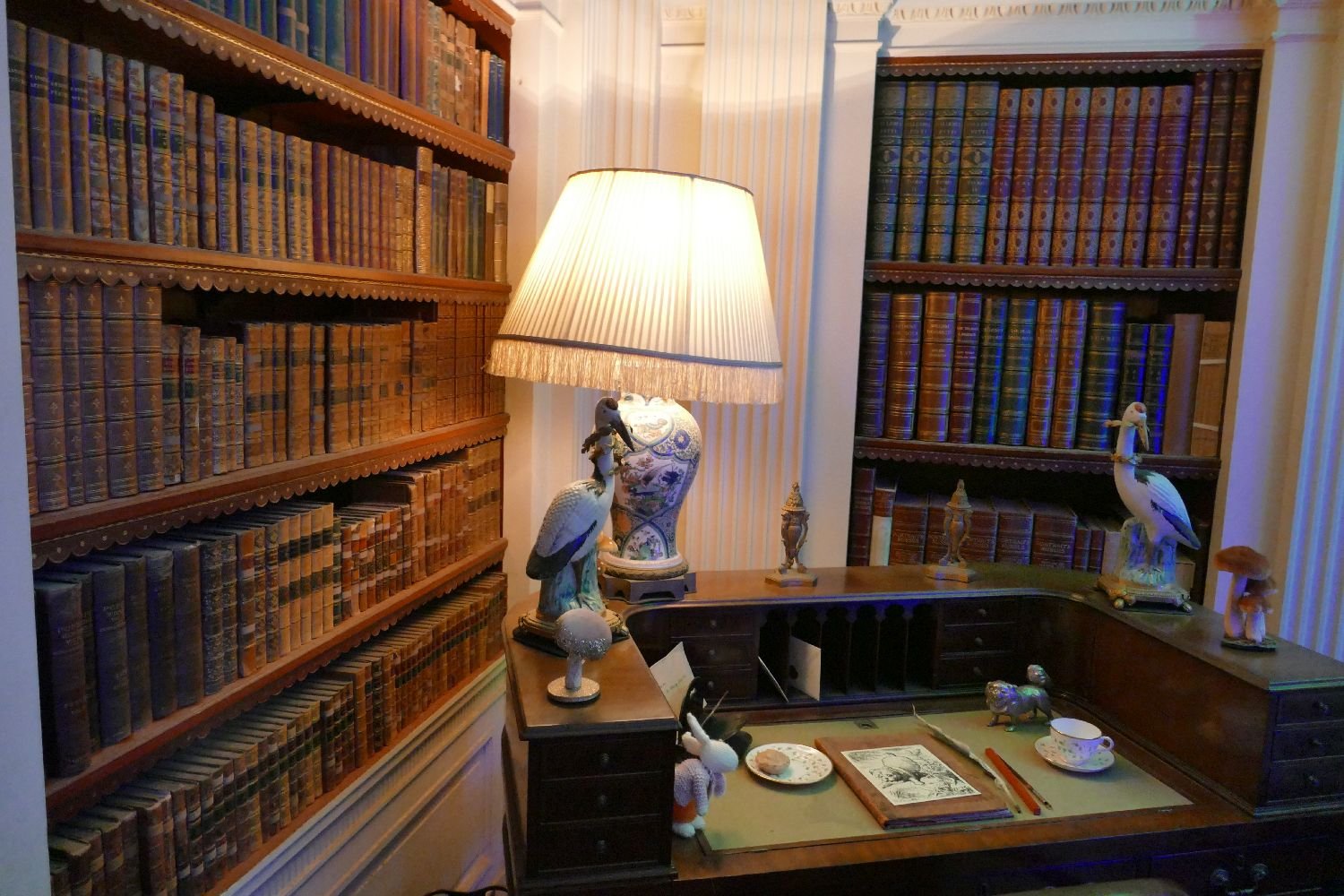
Once we had adjusted our mind set, we pressed on through the Wonderlandscape. We had to queue to get into the library but at least we weren’t forced to drink strange potions or nibble on dodgy biscuits. Entering the room at our normal height we looked around at the comfortable array of leather bound books and a writing desk of apparently unimpeachable character.
But look more closely dear reader: what Edwardian furniture would sport such strange objects as ceramic fungi and a small white rabbit? Suddenly a Cheshire cat appears and, yes, it’s ‘Behind You’, a worryingly psychedelic array of toadstools. The children seemed to love it. Although we suspected that the hookah smoking caterpillar was perched a little above their eyeline.
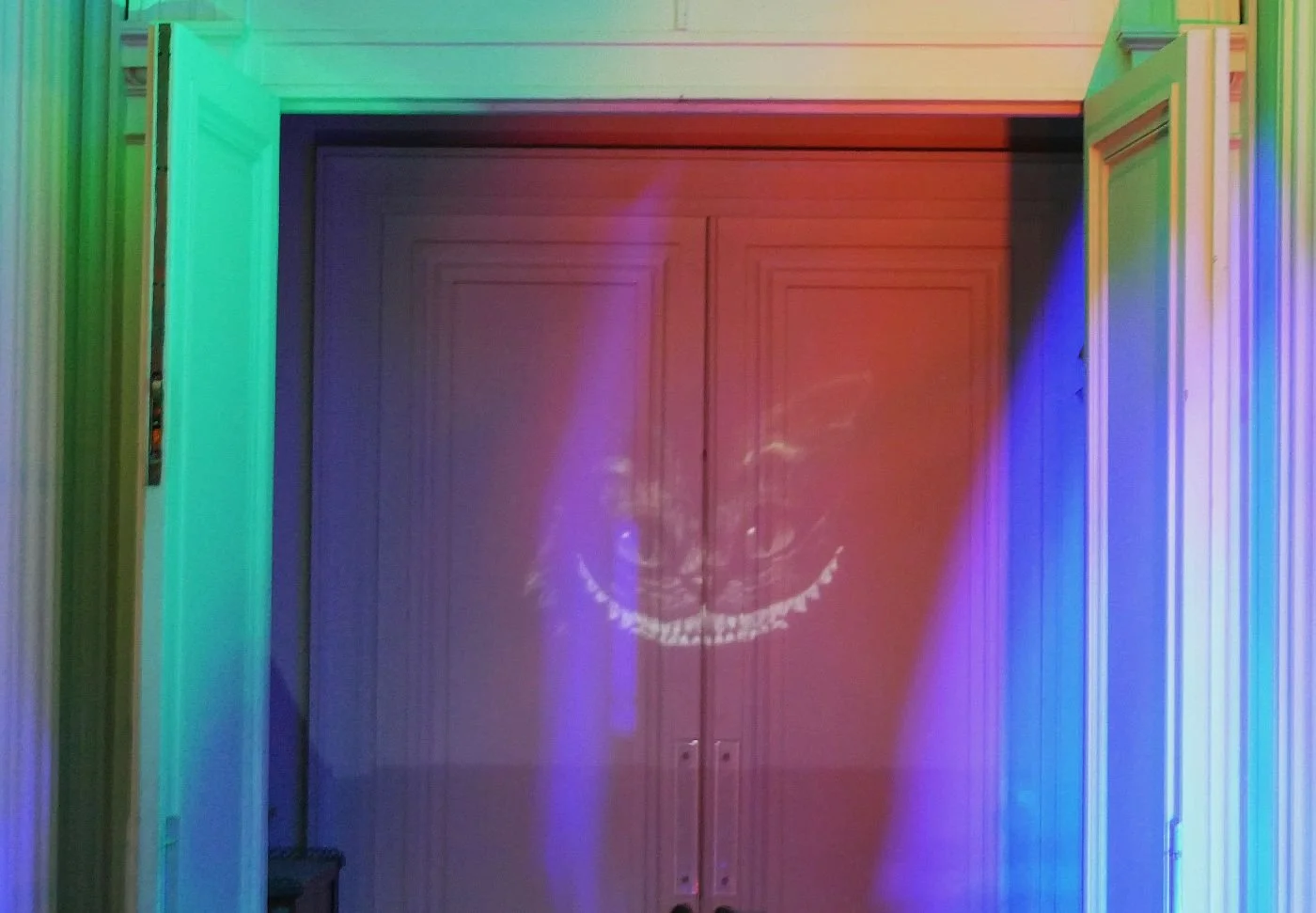
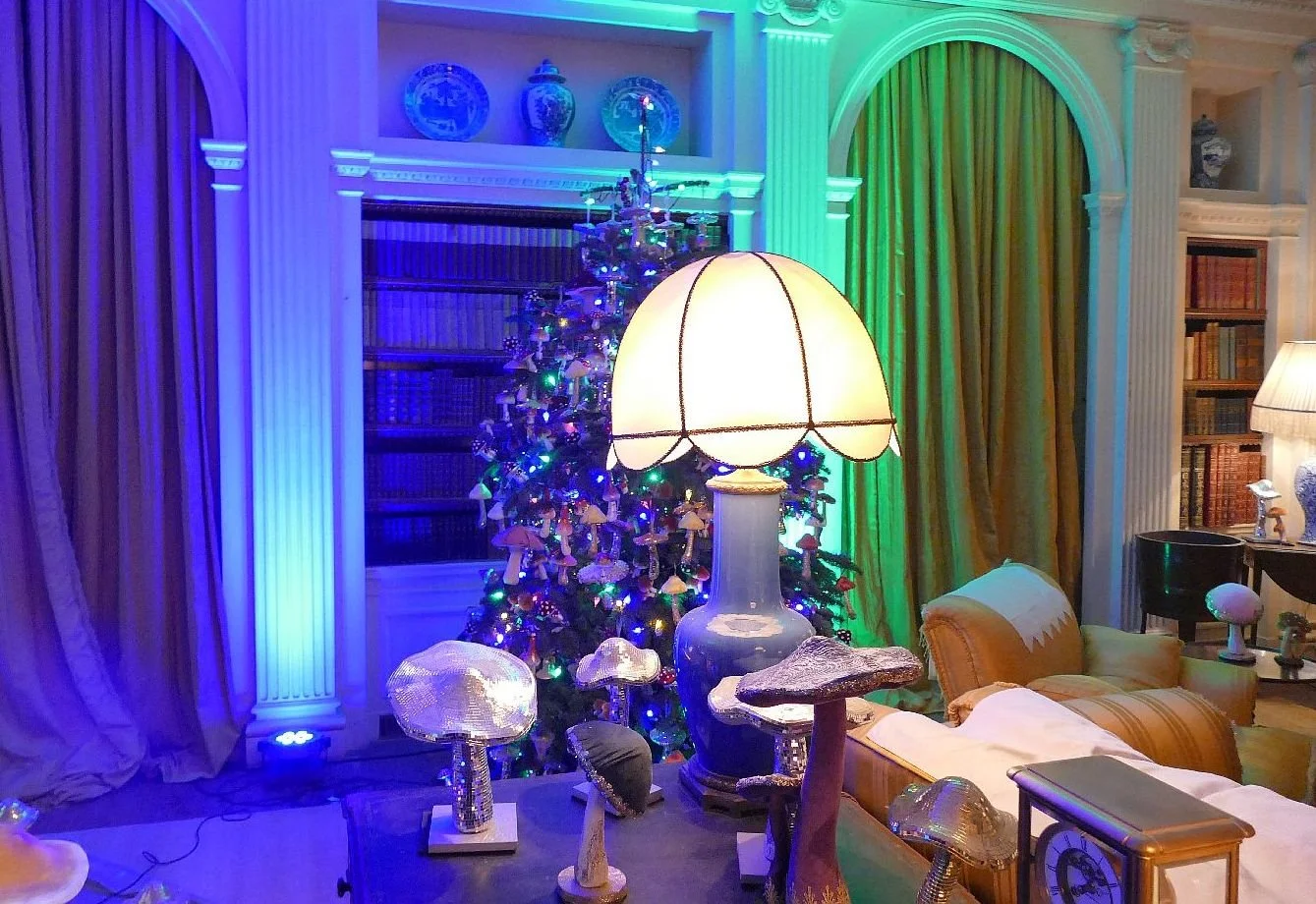
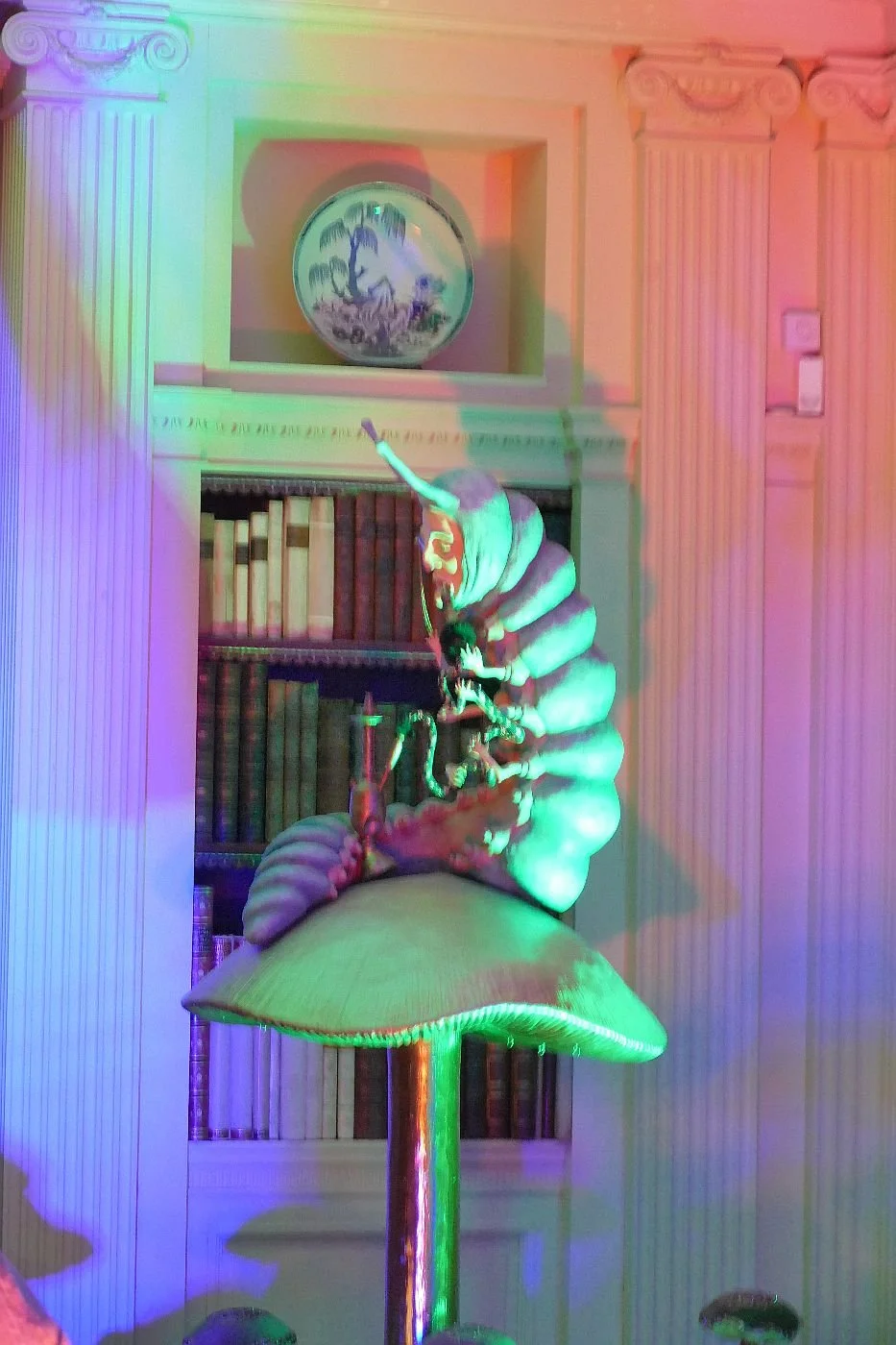
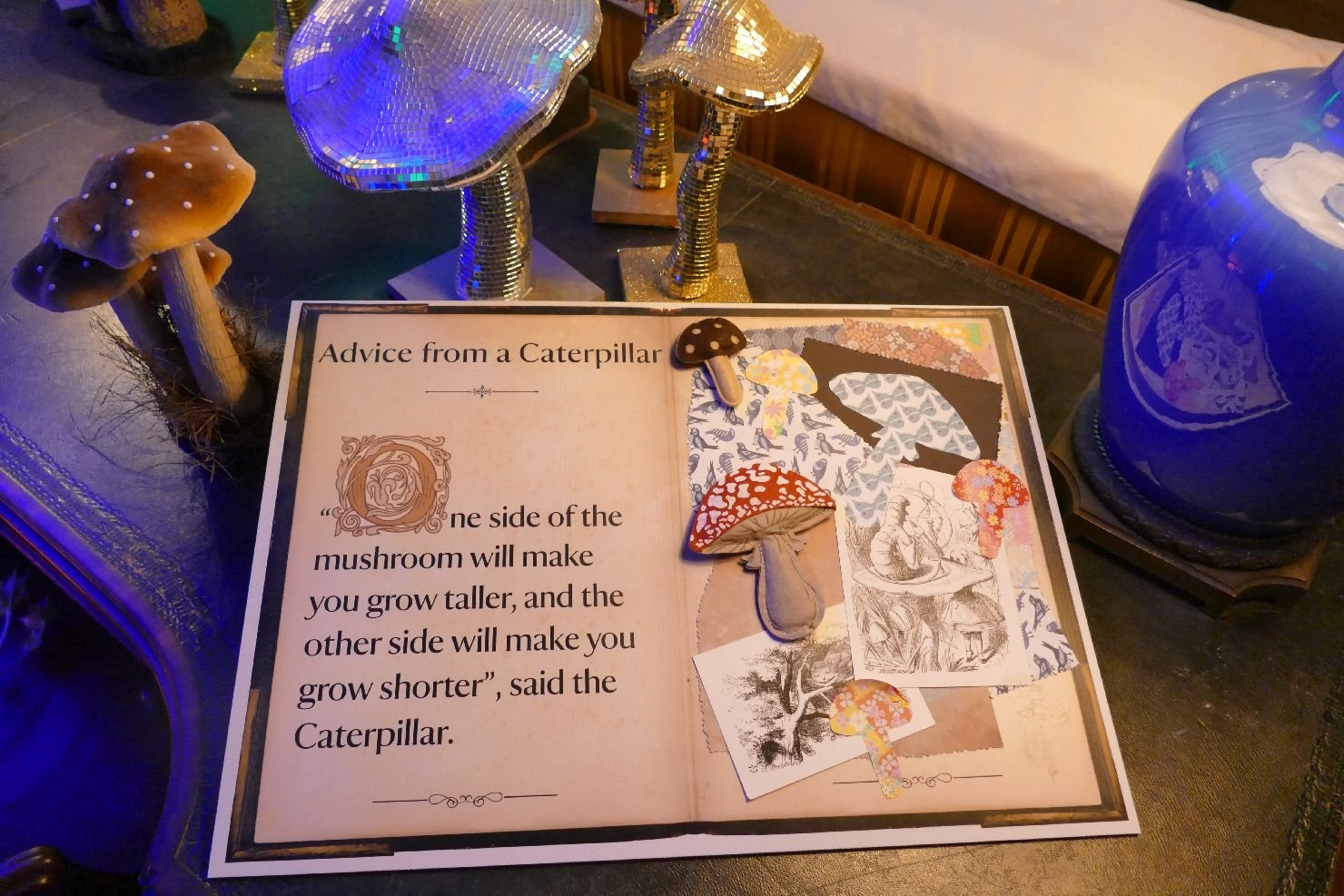
A flexible smoking insect was nothing compared with the Mad Hatter’s tea party and I don’t think either Lewis Carroll or his illustrator Sir John Tenniel had imagined such a colourful riot. We certainly didn’t when we read the book. To be honest, I think One of Us was more terrified by Tenniel’s grey, Victorian illustrations than by any aspect of the text.
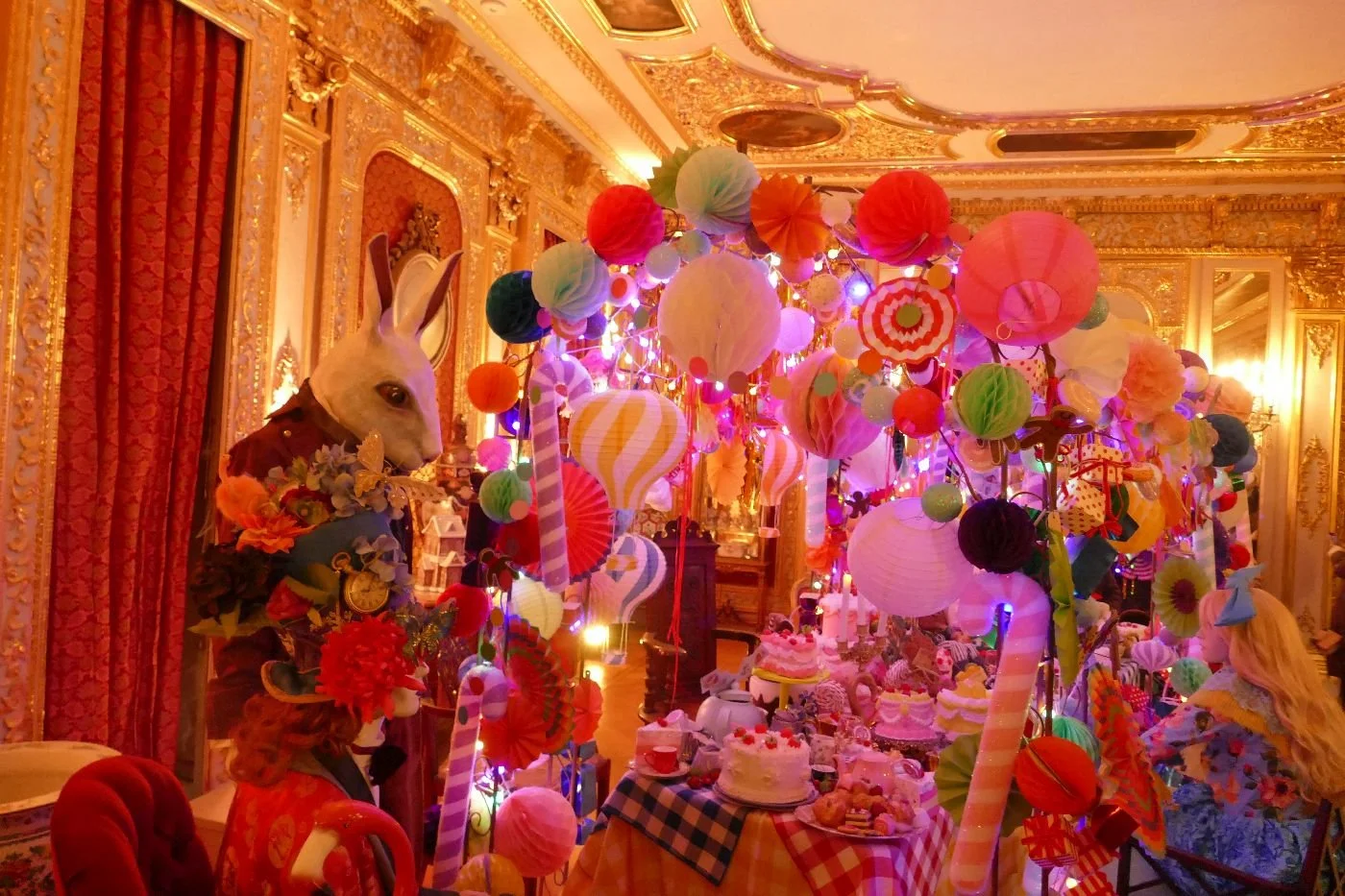
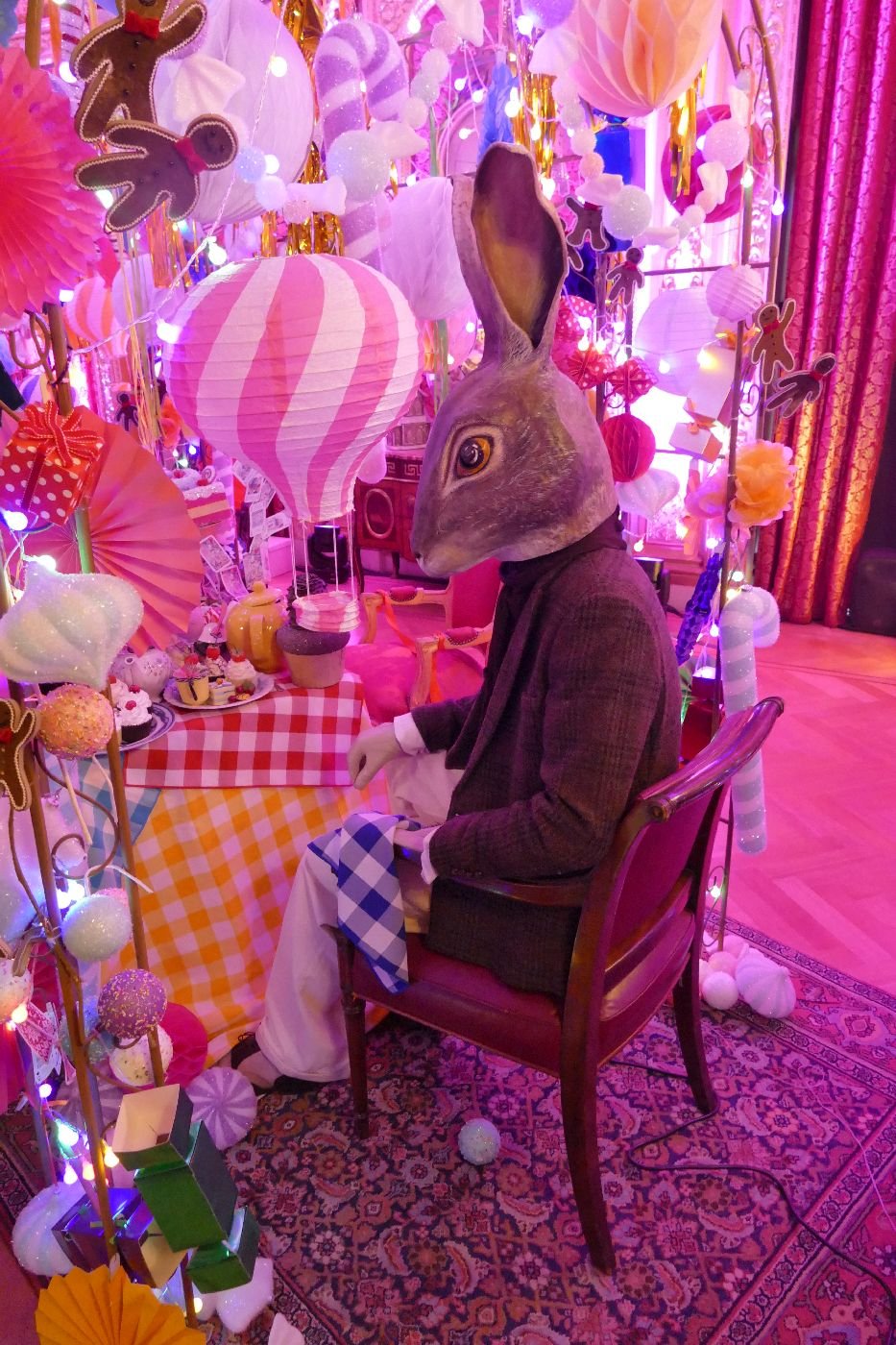
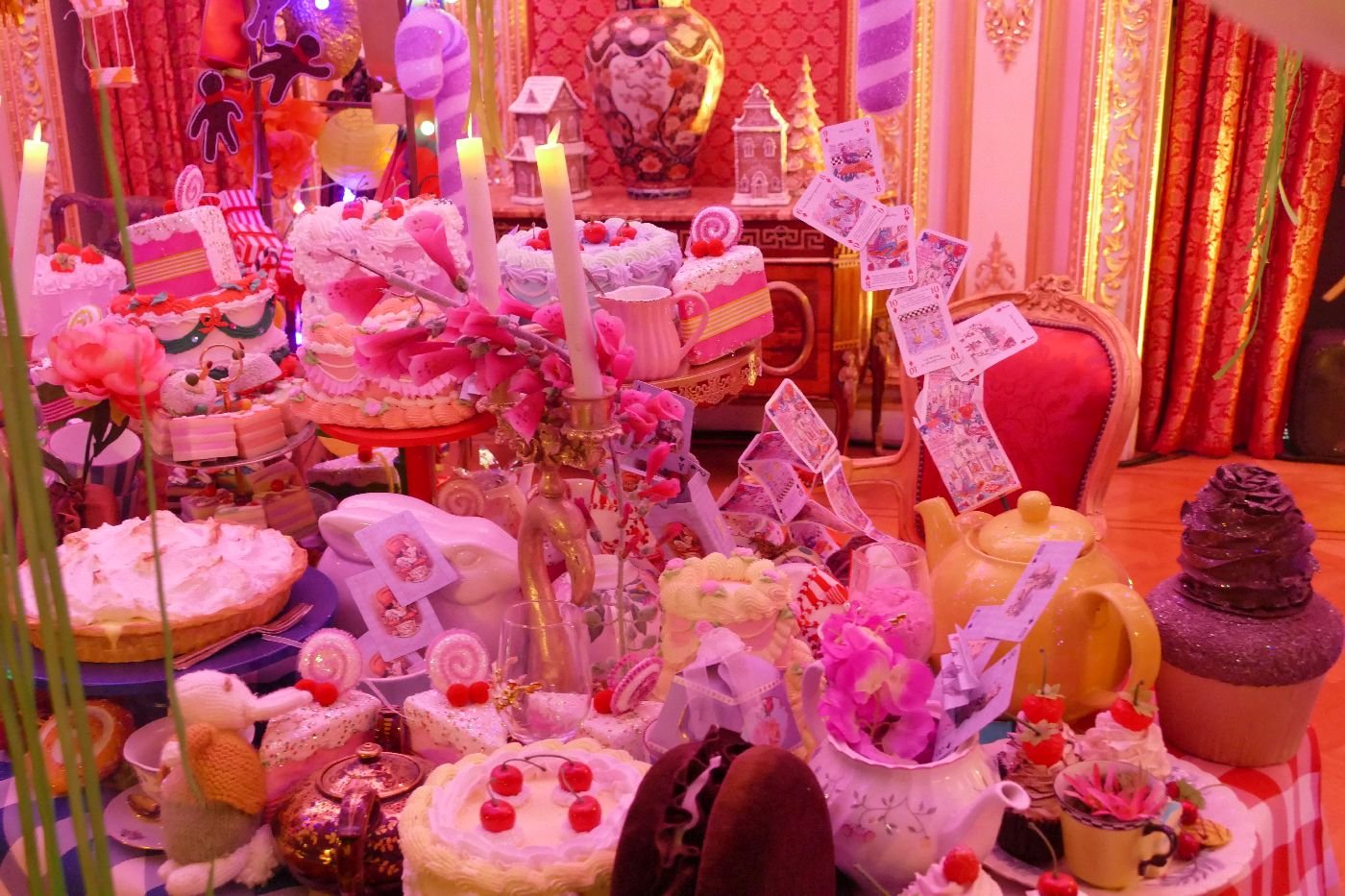
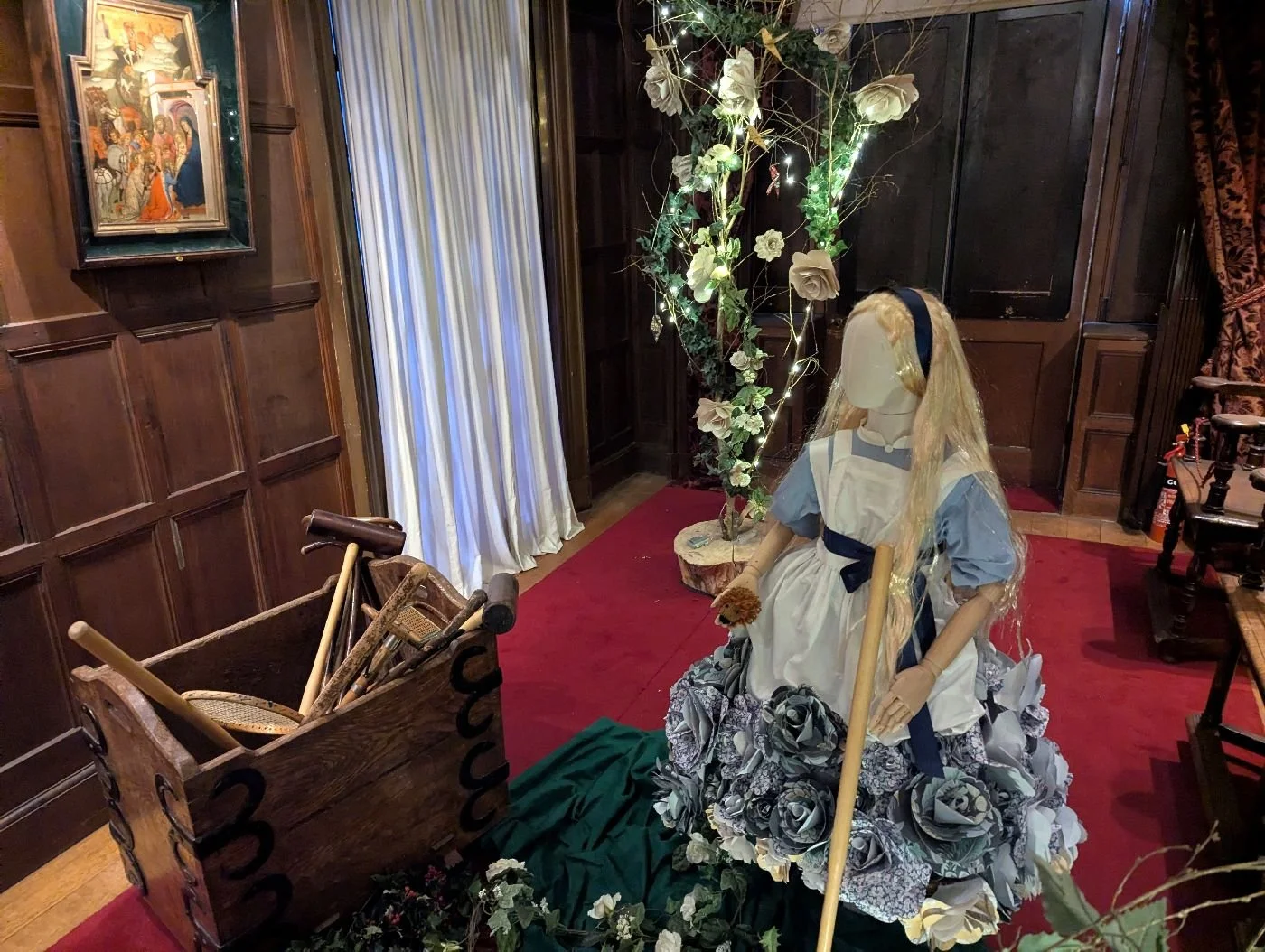
It’s all there – croquet, chess, criminality (who stole the tarts?) but if the trial of the Knave of Hearts was reconstructed, I’m glad we missed it.
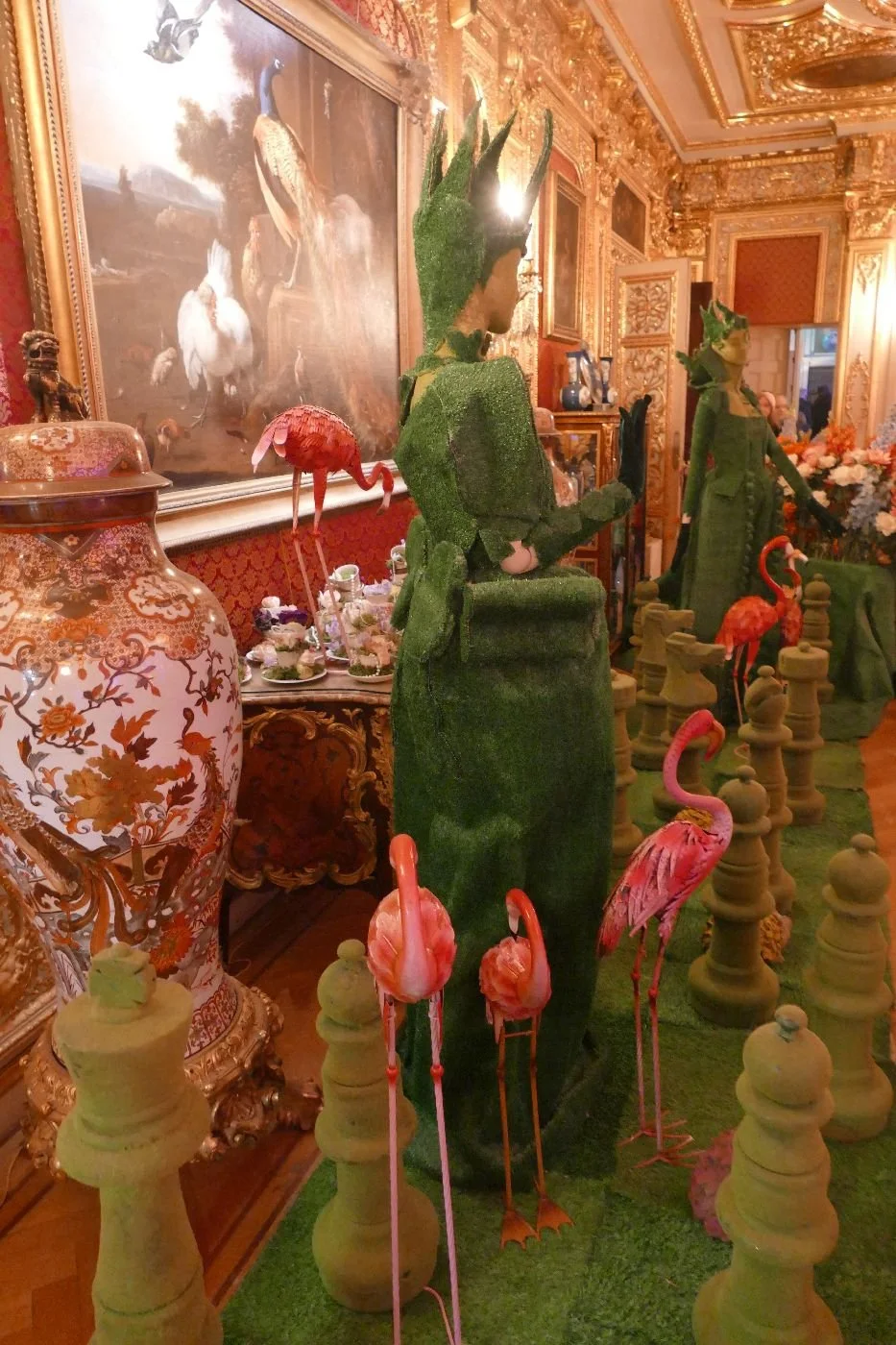
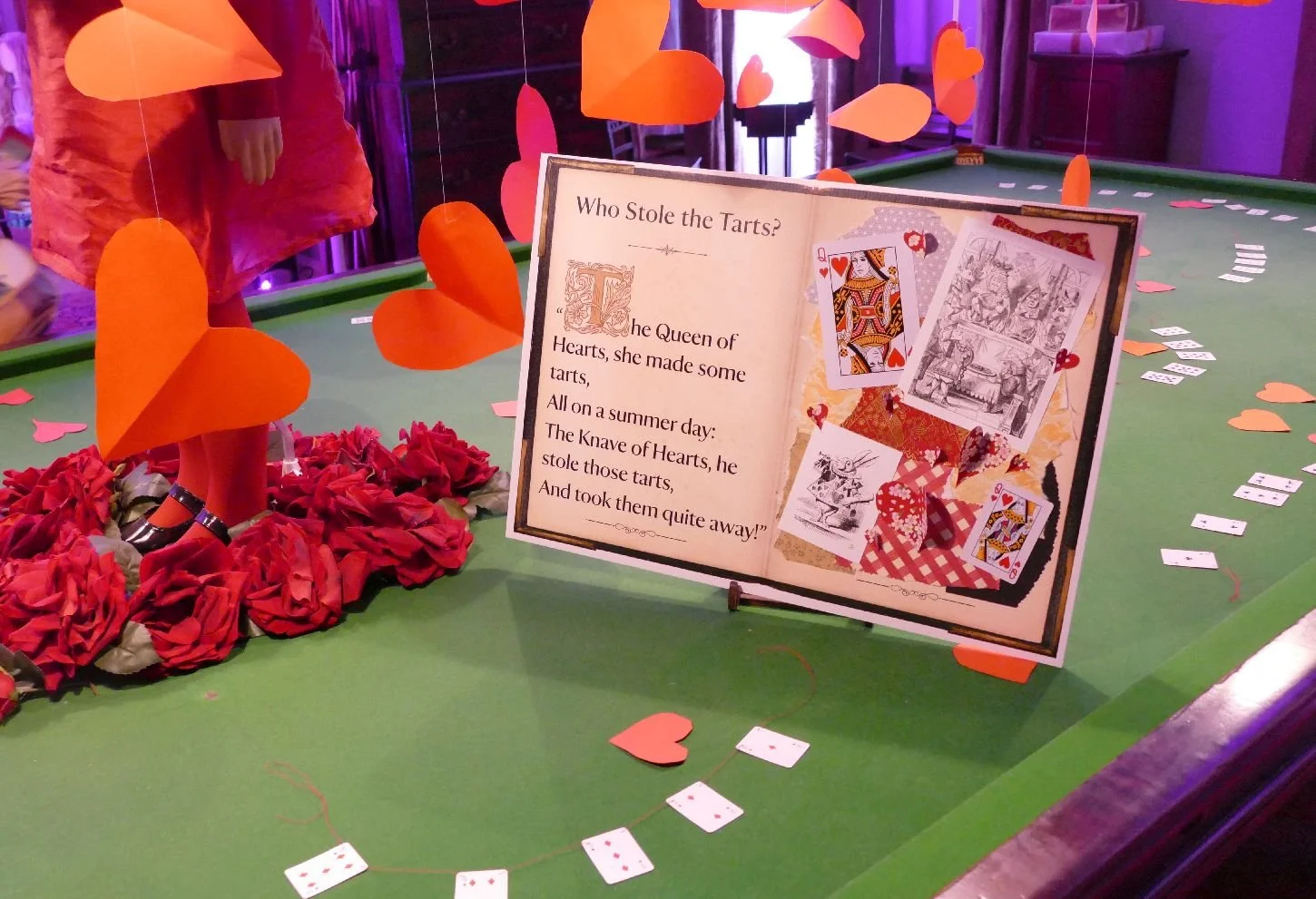
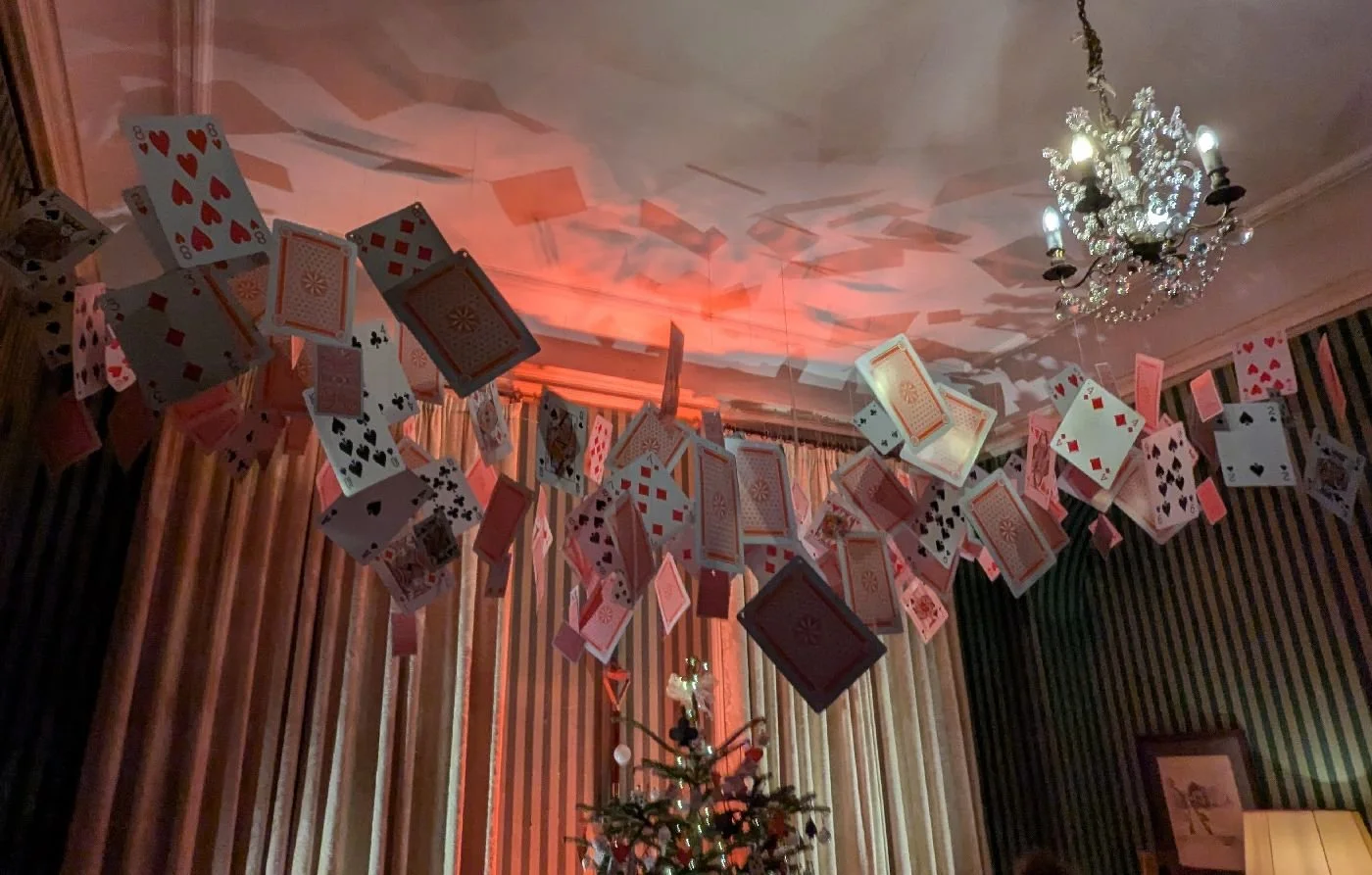
As we stumbled into another dimly-lit, potenial cave of horror, One of Us cried out, in joyous relief, ‘You’re Nothing but a pack of cards!’. We could so imagine Alice’s relief at finally taking control and waking up.
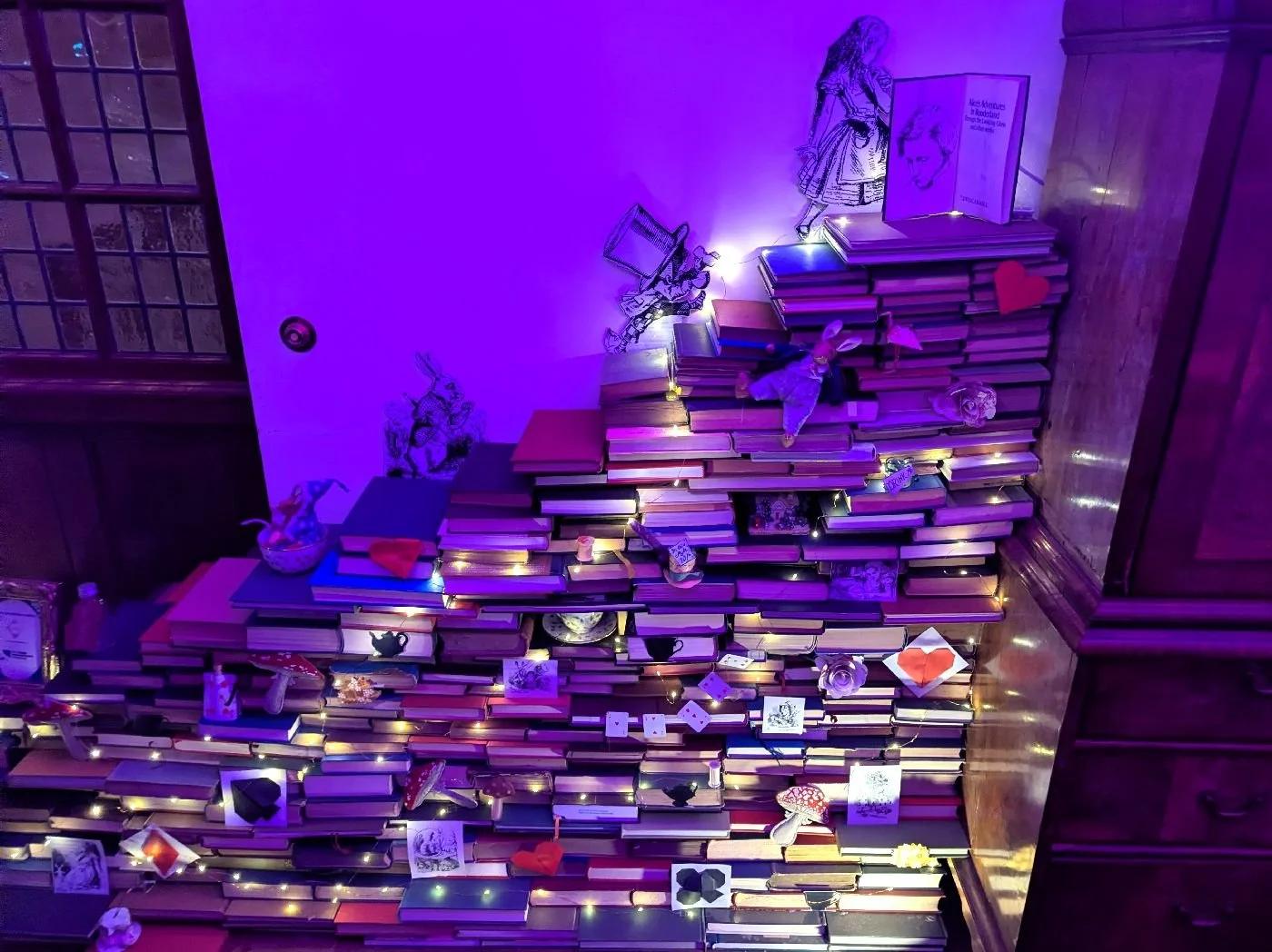
But we, the visitors, hadn’t woken quite yet. There was one last room where the designer had added a little bit of their own magic. There, tucked away in narrow corridor, was a ‘dry book wall’ looking like nothing so much as Welsh slate steps, leading Alice out of the rabbit hole and back to her sister on a Surrey river bank. Pure ‘wonderlandscaping’ wizardry.