Yukon Breakup
Expecting a ‘Yehaa!’ or a ‘Howdy’? No, ‘sut mae’ would be more appropriate. This isn’t north western Canada but it is north west Wales, the land of Welsh speakers and slate mines. Except that Klondike Mill is a lead processing plant.
We have been walking in the woods above Betws-y-Coed in an area which I later discover is called the Gwydir Forest Park. This appears to be a Natural Resources Wales (NRW) non statuatory designation, big on access – the walking, riding and cycling variety – and light touch tourism. The NRW website says that the Park covers an area of 72 sq km, and that ‘Since Victorian times, generations of visitors have walked the woodland paths’. https://naturalresources.wales/days-out/places-to-visit/north-west-wales/sawbench/?lang=en
Indeed, the forest area is riddled with tracks, the sort the Ordnance Survey (OS) describes ominously as ‘Other road, drive or track’, so lowly that they have not been attributed with any colour coding at all, and which my father, a petrol head in love with our first car (an early and second hand Austen A40), would absolutely refuse to drive down. The threat of reaching our destination by a ‘white road’ became a standard family joke.
Although much of Gwydir forest appears to be coniferous (the map is speckled with those iconic, but totally unrealistic, miniature Christmas tree pictograms) our way is through deciduous woodland, twisted, gnarled and dripping with moss. Sessile oak, silver birch, the occasional rowan, and teasing glimpses of other worlds below or beyond us. So far so wonderful.


But on breaking through the tree line to admire a view we come across an example of the other great feature of the Gwydir forests. The NRW website continues, ‘Today, waymarked walking trails allow visitors to explore this landscape of lakes, forests and mountains and learn about its mining history’ … ‘Between 1850 and 1919, lead and zinc mining dominated the area. The legacy of old engine-houses, waste tips and reservoirs are characteristic features of the forest landscape today.’ Forget the ‘generations of visitors’, welcome to the tracks and paths of the miners and mineral workers. Welcome to Klondike Mill! Klondike? Really? Read on.


The Mill was built in 1899 and contributed to an already semi industrialised landscape. A fascinating and detailed Wikipedia article tells its story, one of technological ambition, the economic frailty of mineral extraction and processing, and of subsequent financial and business intrigue. I would add that it is also a story of landscape and environmental impact.
In 1899, it seems that a company called the Welsh Crown Spelter Company (supported by an English company of similar name), purchased and worked a number of lead mines in the area. With expansion in mind, a new and large ‘dressing mill’ was planned for the valley below us. Ore was to be transported to the enormous mill building from the nearby Pandora mine (another great name) by a 2 mile tramway and delivered to the upper storey of the mill by an aerial runway. I can feel the bills mounting as I write.


Power was to be provided by state of the art electricity thanks to Llyn Geirionydd, a nearby lake which had already been conscripted to serve the local mining industry by providing a water supply and power for a generator. A pipeline was now constructed from Llyn Geirionydd to bring water to a tank above the mill, the flow from which powered the mill’s turbine room. The company built a new road, installed the necessary equipment, built enormous shallow holding tanks for effluent and even opened a new mine, next to the mill. Between 100 and 150 staff were employed.


The company’s consulting engineer assured shareholders that ‘the future was bright’, but no ore was processed until the latter part of 1902. Inevitably, debts were enormous, the price of ore was dropping and the mine never returned a profit. The Company went into voluntary liquidation in 1905, although the mill staggered on until 1911.
My thanks to https://en.wikipedia.org/wiki/Klondyke_mill for so much detail on this fascinating industrial landscape. What the website isn’t able to tell is the tale of the people who worked there, the conditions of the industry, nor the hardship which must have occurred as a result of this story.
But there is more: it appears that the name ‘Klondike Mill’ only came about due to a gold rush style scam operated in the 1920s. An article published in the Mining Journal in May 1920 implied that the local silver-lead mines had struck a rich lode, and one Joseph Aspinall spent much time and money enticing would be investors. The perpetrator is thought to have been rumbled, however, by another local mine owner, and was imprisoned. But the name of Klondike stuck.
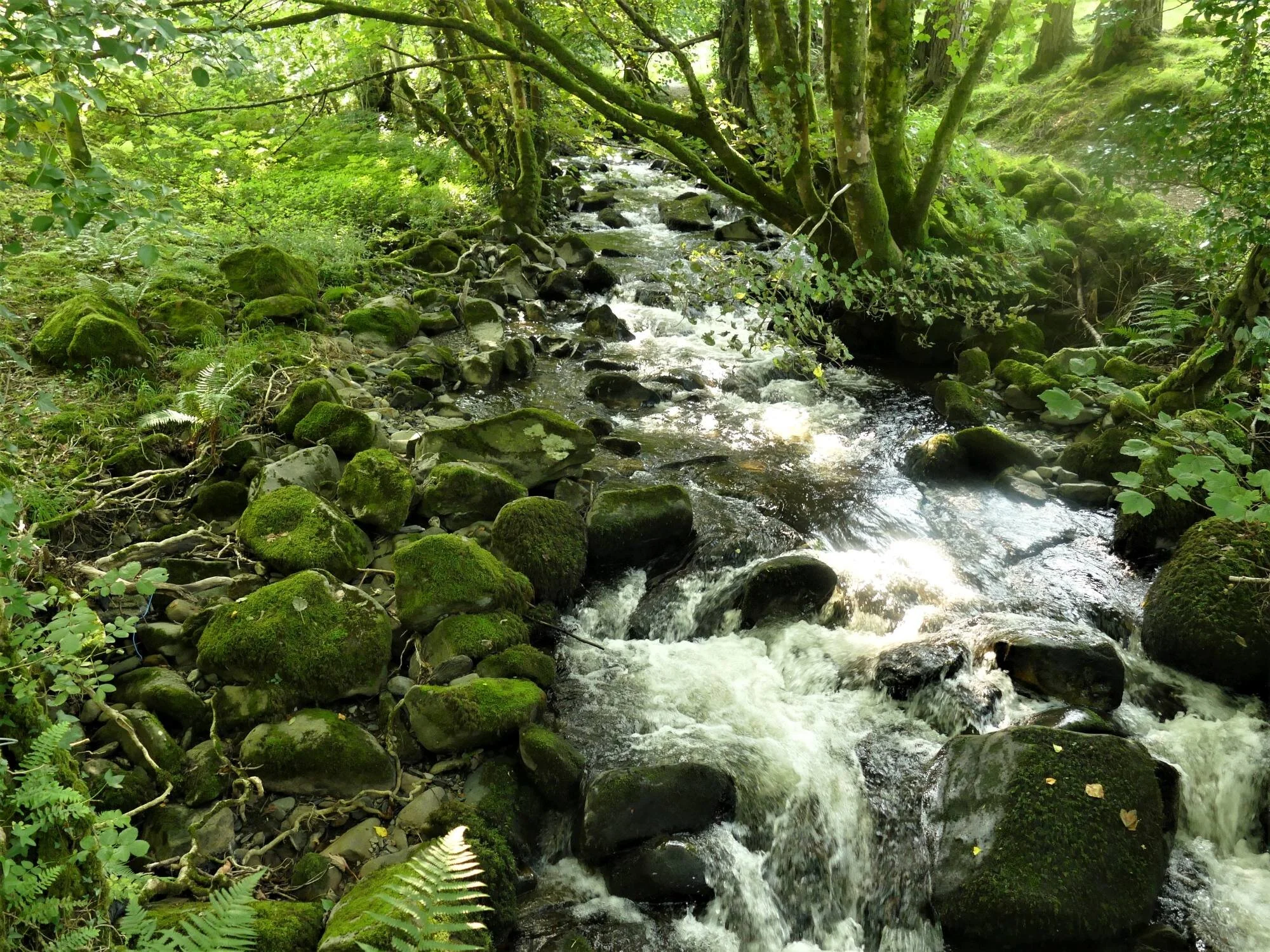
How long does it take for an abandoned industrial site to become a piece of archaeology, a piece of heritage and a tourist asset, rather than a blemish or an intrusion? The mill building is now a Scheduled Monument in the care of Cadw. The ruins are stunning, eerie and well worth a visit. The site is rich in industrial archaeology and a wonderland for landscape detectives, but sadly, still a silent witness to its social history. Over 100 years later, the waste heaps below the mill remain bare and sterile, presumably due to lead contamination. A quick search of the internet still hints at water pollution in the local streams and rivers from the zinc and lead mines; I would be grateful for any further information on this.

Moorish Magic
It all begins with an idea.

The Moors - just 6 miles from the M25
Mention ‘post war Surrey’ and phrases such as Arts and Crafts, stockbroker belt, Tudorbethan, London sprawl, privet hedges, green belt, housing estates or commuter land may come to mind. Yet Surrey has a long history of industry and mineral extraction which often lies forgotten. River valleys such as the Tillingbourne and the Wandle were once lined with mills. In the 1600s the Tillingbourne valley was probably the most industrialised in England and its mills continued working into the 20C. Think gunpowder manufacturing, paper-making, tanning, iron-forging, wire-drawing as well as the more rural corn milling. https://www.surreyhills.org/surrey-hills-60/the-mills-of-the-tillingbourne/ The Wandle, a chalk stream rising on the London facing flanks of the North Downs, supported copper working, tobacco milling and textile mills, amongst many others. https://wandlevalleypark.co.uk/projects/wandle-mills/

Site of the Mixing House at Chilworth Gunpowder Works, Tillingbourne Valley Photo: Tillingbourne Tales Project © The Surrey Hills Board.
Mineral extraction is also no stranger to Surrey. The parallel belts of chalk, clays and greensand have supported a great number of local industries. Mineral winning cannot, to use a planning term, be a ‘footloose’ affair and before Surrey developed good road transport links, mineral based industries remained local to their source material, hence the Surrey lime kilns, or the brickworks which made wonderful, local clay bricks and tiles, which literally supported the vernacular architecture of many Surrey villages and towns.


Which brings me to sand extraction, and my own neighourhood terroir - The Moors – which provided so many of us with our local lockdown breathing space. ‘Moor’ is not a typical component of Surrey place names. Dry, acid Heaths are very Surrey, but Moors, often associated with damp, and upland acid places, are rare in the locality. I suspect damp is the key here, and a strategically placed information board gives us the following: ‘Moor is old Saxon for marsh, and surviving Saxon documents describe the area as ‘marshy with black peaty pools’’.
The Moors isn’t (aren’t?) a typical component of urban fringe open space, either. This long, irregular sliver of land is sandwiched between a landfill site, based on former Fuller’s Earth extraction (thanks to the clay) and a railway line known as, yes, the Quarry Line, (thanks to The London, Brighton and South Coast Railway), and the Moors themselves is/are largely based on restored sand workings. Am I losing you now? Please stay and experience this glorious if quirky piece of open space.


Designated as a nature reserve earlier this century, as an adjunct to, yes, substantial residential development on the sand quarry workings, The Moors was designed as an area of seasonal wetlands and links to further flooded sand pits, before the whole shebang butts its head against the chalk ridge of the North Downs. The local Brook flows gently through, an apparently bucolic and lowland affair, but which is intimately (if benignly) linked to land fill drainage, and which can suddenly flex its muscles when winter downpours swell its load and water surges dramatically over the banks to turn adjacent wetlands into substantial lakes.


The valley footpath has changed from a muddy, puddle jumping, childhood enhancing experience to National Cycle Route 21 (Greenwich to Eastbourne) which has greatly extended usage and accessibility to quality green space. Part of me, however, still misses the slow, tranquil, low key ‘walk to the stream’, although fitness levels have universally increased, as pedestrians may now need to leap smartly to one side to allow the faster runners and cyclists through: the inevitable compromises of urban living.
So, yes, we get the quirky; but where’s the glory? Despite, or maybe because of, the total lack of maintenance during lockdown, this year’s summer wildflowers were a stress buster in themselves. Colour, vibrancy, mass, movement and tranquillity were there in spades. A smaller wetland was dry, revealing a massive horizontal poplar trunk and the largest burdock plant I’ve ever seen: the very best of natural play.


The bigger wetlands were, well, pretty wet, and busy with swans, egrets, ducks such as teal and mallard, cormorants and great crested grebe. Sure, the paths run close to the land fill site and the railway embankment, but glance over to the other view: rushes moving in the breeze, mass swathes of natural colour, poplars swaying gently, veteran oaks of enormous stature marking a former field boundary, butterflies and bees in thrall to nectar, and those stunning views of the North Downs.


To be honest, the landfill’s methane guzzling generators are noisy and sometimes smelly, but most of us forgive them as they seem to represent a positive outcome from our dreadful habit of throwing our rubbish into holes in the ground. But then there is the ‘hedge on legs’ which is what you get when you don’t trim hedge plants on a regular basis or remove stakes and shelters. It provides an excellent green screen between cycle path and nature reserve, but it needs a fence to keep the cattle (sorry, conservation grazers) in and the dogs out. It’s not what I call a hedgerow.
But despite the urban quirks, the ‘promise’ of a landscape, in terms of space and time, is perfectly encapsulated in The Moors. This space is connected: cyclists – if you keep going, Paris is a just a designated cycle path away; pedestrians - home is a short stroll along the valley; for the more energetic, those North Downs are easily accessible by footpath and bridleway; bird watchers and butterfly spotters, this is for you; shoppers, Sainsbury’s is only a 20 minute walk and, according to Google Maps, ‘mostly flat’. In time terms too, the offer is good. ‘Seasonal wetlands’ means seasonal change. Different birds (snipe in winter), different berries, different colours, and always water – more water, less water and sometimes, when the footpath floods, just a little bit too much water. https://www.surreywildlifetrust.org/nature-reserves/nutfield-marshes-inc-moors-spynes-mere-holmethorpe-lagoons

Welcome
It all begins with an idea.

Welcome to Terroir - a blog about our landscape and environment
Terroir has been in gestation for many years but to go live during an international pandemic with severe movement restrictions may seem downright perverse. Nothing, however, has taught us the value of our landscape, our outdoors - our shores and mountains, our streets and neighbourhood parks, our commons and heaths, our cities, towns, and villages, our rivers, woodlands and fields, our whole and holistic environment, our terroir - like the Corona revolution.


Ladies and Gentlemen, Mesdames, Messieurs, may I present - TERROIR